Why Small Businesses Benefit from an Outsourced Data Protection Officer (DPO)
Data Protection is Growing. So Are the Challenges.
As organisations become increasingly reliant on customer data, cloud technology, AI tools, digital marketing platforms and third-party suppliers, the need for robust data protection governance has never been greater.
Many organisations recognise the need for a Data Protection Officer (DPO), yet struggle to appoint someone internally who possesses the necessary expertise, independence and authority required under data protection legislation.
For small and growing businesses in particular, an outsourced DPO can provide an effective, independent and commercially sensible solution.
At GRC Hub, we regularly support organisations that want to strengthen their data protection framework whilst avoiding the conflicts, resource challenges and governance issues that often arise when appointing an internal DPO.
What Is a Data Protection Officer?
A Data Protection Officer (DPO) is an individual responsible for advising an organisation on its data protection obligations and monitoring compliance with data protection legislation such as the UK GDPR and Data Protection Act 2018 and more recently the Data (Use and Access) Act 2025.
The DPO’s responsibilities typically include:
- Advising the organisation on data protection obligations
- Monitoring compliance with applicable legislation
- Supporting Data Protection Impact Assessments (DPIAs)
- Raising awareness and delivering training
- Acting as a point of contact for regulators and data subjects
- Providing independent oversight of data protection activities
Importantly, a DPO is not responsible for making business decisions regarding how personal data is used (unlike the data controller). Instead, they provide independent advice, challenge and assurance to ensure that data protection risks are understood and managed appropriately.
What Is a Data Controller?
One area that frequently causes confusion is the distinction between a DPO and a Data Controller.
A Data Controller is the organisation or person that determines:
- Why personal data is processed
- How personal data is processed
- What systems and processes are used
- How long information is retained
- Who information is shared with
In simple terms:
The Data Controller makes the decisions.
The DPO advises on those decisions.
The DPO should never be placed in a position where they are responsible for determining the purposes or means of processing personal data, because doing so would create a conflict of interest.
Why Independence Matters
The GDPR intentionally establishes the DPO as an independent advisory function.
The legislation requires that:
- The DPO reports to the highest level of management
- The DPO is involved in data protection matters in a timely manner
- The DPO is not instructed on how to perform their tasks
- The DPO is not penalised for carrying out their duties
- The DPO does not hold a position that creates a conflict of interest
The purpose of these requirements is straightforward.
An organisation needs someone who can objectively assess privacy risks and provide advice, even when that advice may be unpopular or challenge existing business practices.
Without independence, the DPO role becomes ineffective.
The DPO should be pictured in a silo, outside of other business interests and have a duty to data subjects.
The Reality: Many DPO Appointments Are Not Truly Independent
Despite the regulatory requirements, many organisations continue to appoint individuals to the DPO role who are simply unable to remain independent.
Common examples include:
- Director of IT
- Chief Technology Officer
- Head of Information Security
- Director of Finance
- Operations Director
At first glance, these appointments may appear logical. These individuals often possess strong organisational knowledge and a broad understanding of compliance requirements.
However, many of these positions simultaneously make decisions regarding the processing of personal data.
This means they may be reviewing and assuring decisions that they themselves have made.
In governance terms, this creates a clear conflict of interest.
This challenge becomes even more pronounced within smaller organisations where individuals are often required to perform multiple roles and wear numerous hats.
In many growing businesses, there simply may not be a suitable internal candidate capable of fulfilling the DPO role whilst remaining truly independent.
Why Many DPOs Leave Their Roles
Although limited formal research exists specifically on DPO retention, industry surveys have consistently identified challenges relating to independence, insufficient resources, lack of senior management support and role ambiguity. Recent European surveys have highlighted concerns around workload, reporting lines, additional responsibilities beyond GDPR requirements and difficulties maintaining independence. [edpb.europa.eu], [cedpo.eu], [cedpo.eu]
At GRC Hub, we frequently encounter organisations where the DPO function has experienced high turnover.
In our experience, DPOs often become frustrated when:
- Their advice is routinely ignored
- They lack authority or influence
- They are excluded from decision-making processes
- They are expected to hold accountability without sufficient resources
- They are prevented from operating independently
- Data protection is not discussed at board level
- The role is treated as an administrative task rather than a governance function
The most effective DPOs are generally those who have access to senior leadership, sufficient independence and a genuine opportunity to influence organisational culture.
When these conditions are absent, DPOs often feel unable to perform their duties effectively.
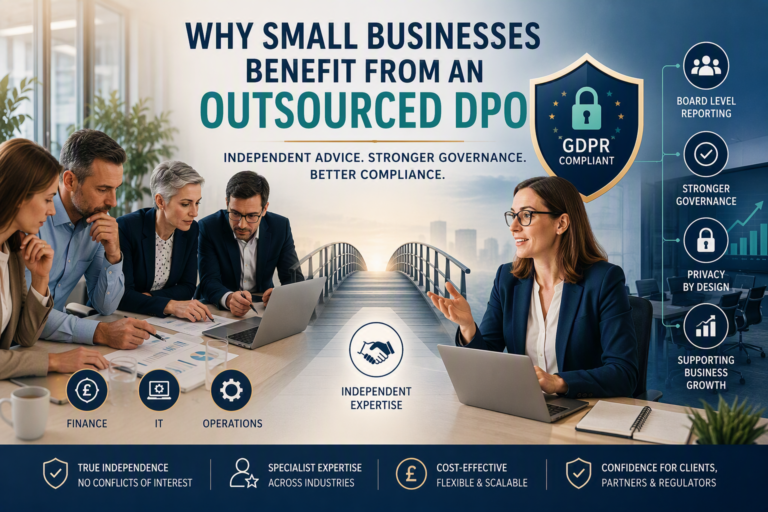
Why Small Businesses Benefit from an Outsourced DPO
An outsourced DPO model addresses many of these challenges.
Genuine Independence
An external DPO is not involved in the day-to-day operational decisions regarding personal data.
This allows them to provide truly objective advice and oversight without conflicts of interest.
Independence is not just a regulatory requirement; it creates confidence that privacy risks are being assessed appropriately.
Access to Specialist Expertise
Data protection legislation continues to evolve.
Organisations must now consider:
- UK GDPR
- International data transfers
- Data subject rights
- Supplier due diligence
- AI governance
- Cybersecurity expectations
- Information governance requirements
An outsourced DPO typically works across multiple sectors and organisations, bringing broader experience and practical insight than many organisations could realistically maintain in-house.
Cost Effectiveness
For many SMEs, recruiting a full-time experienced DPO is simply not commercially viable.
An outsourced arrangement allows organisations to access senior expertise on a fraction of the cost of a permanent hire whilst still benefiting from ongoing support and strategic oversight.
Stronger Governance
An independent DPO is more likely to raise concerns, identify gaps and challenge assumptions.
This helps organisations strengthen governance structures before issues develop into regulatory investigations, complaints or reputational damage.
Building Data Protection by Design from Day One
One of the most overlooked benefits of appointing an outsourced DPO is the ability to embed privacy into business operations from the outset.
For start-ups and scaling businesses, early involvement allows data protection considerations to be built directly into:
- Business processes
- Technology platforms
- Marketing activities
- Customer onboarding
- Supplier management
- Product development
- AI governance frameworks
Rather than retrofitting compliance at a later date, organisations can establish robust controls as they grow.
This approach often results in lower compliance costs and fewer operational disruptions in the future.
Supporting Growth and Winning New Business
As organisations mature, customers increasingly expect evidence of privacy governance.
Procurement teams frequently ask questions about:
- GDPR compliance
- Security controls
- Data retention practices
- International transfers
- Third-party risk management
- Data protection governance
Without the appropriate governance structure in place, businesses can find themselves struggling during customer due diligence exercises.
An outsourced DPO helps demonstrate that data protection is being taken seriously and provides assurance to customers, investors and business partners.
For many growing organisations, this can become a commercial advantage rather than simply a compliance requirement.
FAQs
Can a CEO be a Data Protection Officer?
Generally, no. A CEO usually determines how personal data is processed and therefore cannot maintain the independence required of a DPO.
What is the difference between a DPO and a Data Controller?
A Data Controller decides why and how personal data is processed, while a DPO provides independent advice and oversight of those activities.
Is an outsourced DPO GDPR compliant?
Yes. Both the UK GDPR and EU GDPR allow organisations to appoint an external Data Protection Officer provided they meet the requirements of the role.
How much does an outsourced DPO cost?
An outsourced DPO is typically significantly more cost-effective than employing a full-time privacy specialist and can scale according to organisational needs.
Final Thoughts
For many small and growing businesses, appointing an internal DPO that satisfies both the expertise and independence requirements of the GDPR can be difficult.
An outsourced DPO provides a practical alternative.
By delivering independent oversight, specialist expertise, strategic advice and board-level engagement, an outsourced DPO can help organisations embed privacy by design, strengthen governance and build customer confidence from the outset.
At GRC Hub, we help organisations move beyond tick-box compliance and develop practical, proportionate data protection frameworks that support both compliance and business growth. View our Outsourced DPO Service for more.

Governance Risk & Compliance Hub LIMITED
© 2026 All rights reserved
- Award Winning consultancy
- Email: hello@grc-hub.co.uk
- Phone: +44 (0) 113 532 7830