Fully Outsourced DSARs vs DSAR Software: What's the Best Approach for Your Organisation?
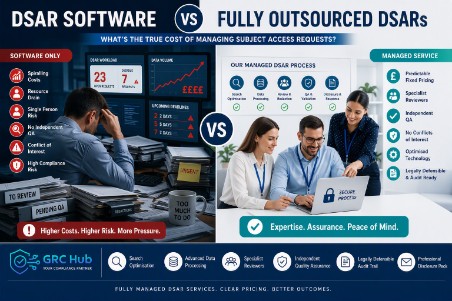
Outsourced DSARs vs Software
As Data Subject Access Requests (DSARs) continue to increase in volume, complexity and regulatory scrutiny, organisations are facing a critical decision: should they invest in DSAR software or outsource the process entirely?
At first glance, DSAR platforms appear to offer an ideal solution. Automated workflows, intelligent searching, redaction capabilities and audit trails promise to simplify compliance and reduce administrative burden.
However, many organisations discover that buying a tool and successfully delivering DSARs are two very different things.
The reality is that software alone rarely solves the problem.
The Promise of DSAR Software
The DSAR software market has grown significantly over the last few years, with vendors promoting increasingly sophisticated capabilities designed to support organisations in responding to data subject rights requests.
Common functionality includes:
- Search and collection tools
- Automated redaction
- OCR (Optical Character Recognition)
- Email threading
- Deduplication
- Workflow management
- Reporting and audit logs
For organisations receiving large numbers of requests and possessing dedicated privacy, legal or eDiscovery teams, these solutions can provide genuine value.
However, technology is only one part of the process.
Software Doesn’t Make Decisions
One of the most common misconceptions around DSAR tooling is that it removes the need for specialist expertise.
In reality, software helps manage and process data, but it cannot make disclosure decisions on behalf of an organisation.
Someone still needs to:
- Determine the scope of the request
- Identify appropriate systems to search
- Develop effective search strategies
- Assess exemptions
- Consider third-party information
- Review and validate redactions
- Make disclosure decisions
- Prepare responses
- Ensure compliance with statutory deadlines
The software may accelerate parts of the process, but accountability remains firmly with the organisation.
For many businesses, particularly SMEs and mid-market organisations, this creates a significant challenge.
The Opportunity Cost Nobody Talks About
When evaluating DSAR solutions, most discussions focus on licence costs and software features.
Far less attention is given to the operational burden and resource requirements that remain even after the software has been implemented.
The question organisations should ask isn’t simply:
“How much does the tool cost?”
It’s:
“How much responsibility, resource and risk does the tool still leave with us?”
The “Team of One” Problem
In many organisations, data protection responsibilities sit with a single individual.
This may be:
- A Data Protection Officer
- Compliance Manager
- HR Lead
- Information Governance Manager
- Legal Counsel
- Operations Manager wearing multiple hats
When a DSAR arrives, that individual often becomes responsible for the entire process.
This includes:
- Scoping the request
- Conducting searches
- Managing exports
- Reviewing documents
- Applying redactions
- Assessing exemptions
- Drafting responses
- Maintaining records
- Meeting deadlines
Instead of reducing workload, the organisation has often simply purchased another specialist platform that requires expertise and time to operate effectively.
This creates a substantial key-person dependency risk.
If that individual is unavailable, leaves the business, takes annual leave or lacks experience with a particularly complex request, the organisation may struggle to respond effectively.
Who Checks the Checker?
One of the most overlooked aspects of DSAR management is quality assurance.
A robust DSAR process should never rely solely on the judgement of a single individual.
Important questions need to be independently challenged:
- Was every relevant system searched?
- Were searches properly scoped?
- Has third-party information been correctly identified?
- Have exemptions been applied appropriately?
- Has anything been missed?
- Has anything been disclosed that should not have been?
Large organisations may have dedicated legal, privacy or review teams available to perform this function.
Most SMEs do not.
As a result, the same individual reviewing documents is often responsible for approving their own work.
This creates obvious compliance risks and removes an important layer of assurance.
The Conflict of Interest Problem
Another challenge rarely discussed is impartiality.
Consider the following scenarios:
- An employee submits a DSAR following a grievance.
- A former employee alleges misconduct.
- A whistleblowing incident triggers a request.
- A customer complaint escalates into legal action.
In many smaller organisations, the individual responsible for reviewing documents and making disclosure decisions may have been directly involved in the events being investigated.
Even where there is no intentional bias, the perception of bias can become problematic.
Independent review provides an objective perspective and ensures disclosure decisions can be defended if challenged by regulators, legal representatives or the individual making the request.
The Cost of Getting It Wrong
Many businesses focus heavily on the cost of DSAR software but fail to consider the potential cost of an incorrect disclosure.
Mistakes can lead to:
- Disclosure of third-party personal data
- Breaches of confidentiality
- Exposure of legally privileged information
- Escalated employee relations issues
- Increased litigation risk
- Regulatory scrutiny
- Reputation damage
The financial and operational consequences of a poorly reviewed disclosure can quickly outweigh any savings achieved through automation.
Internal Time Isn’t Free
Even with sophisticated tooling, DSARs remain resource-intensive.
Time spent:
- Learning new platforms
- Building workflows
- Refining searches
- Reviewing documents
- Conducting QA
- Producing disclosure packs
is time not spent on:
- Governance improvements
- Privacy programmes
- Risk assessments
- Regulatory projects
- Customer support
- Strategic business initiatives
For organisations with limited compliance resources, internal time is often the biggest cost of all.
Technology Isn’t Foolproof
At GRC Hub, we’ve reviewed and tested many of the leading DSAR platforms available today.
While the technology continues to improve, every tool shares one common limitation:
Technology identifies patterns. Humans provide judgement.
Most systems are highly effective at identifying known personal data points such as:
- Names
- Email addresses
- Telephone numbers
- Employee IDs
- National Insurance numbers
However, real-world DSARs frequently involve information that software struggles to interpret accurately.
Examples include:
- Nicknames
- Internal references
- Contextual identifiers
- Historical correspondence
- Third-party relationships
- Content requiring legal interpretation
As a result, automated workflows still require experienced reviewers to validate findings and ensure appropriate disclosure decisions are made.
Technology can assist the process.
It cannot replace expertise.
The Challenge of Tooling Costs
Another frustration organisations frequently encounter is budgeting.
Many DSAR vendors operate using:
- Annual licence commitments
- Minimum spend requirements
- User-based pricing
- Data processing charges
- Additional module costs
This often makes forecasting difficult.
Organisations may find themselves investing significantly in a platform while still requiring internal resource to manage the process.
The economics become even harder to justify when DSAR volumes are relatively low or requests are not large enough to fully benefit from advanced processing capabilities.
Why Fully Outsourced DSARs Are Different
For many organisations, the challenge isn’t obtaining better technology.
It’s obtaining capacity, expertise, independence and assurance.
This is where a fully outsourced DSAR service fundamentally differs from a software-only solution.
Rather than providing another platform to manage, GRC Hub combines technology, people and process into a single managed service.
Our clients benefit from market-leading tools without needing to purchase, configure or operate them internally.
More importantly, they gain access to specialist reviewers with extensive experience managing complex requests.
The GRC Hub Fully Managed DSAR Service
Our fully managed service has been designed to provide organisations with a predictable, defensible and scalable approach to DSAR compliance.
Available through our Bronze, Silver and Gold packages, the service includes:
Search Optimisation
Effective searching is one of the biggest drivers of DSAR efficiency.
Our proven methodologies help organisations identify relevant data quickly whilst significantly reducing unnecessary review volumes and associated costs.
Advanced Data Processing
We utilise sophisticated processing capabilities including:
- Deduplication
- OCR
- Email threading
- Data reduction
- Intelligent automation
This helps reduce review populations and accelerate response times.
Specialist Review Teams
Experienced privacy professionals conduct document review and redaction activities, ensuring decisions are based on expertise rather than guesswork.
Independent Quality Assurance
Every disclosure benefits from independent review and quality assurance, reducing risk and improving consistency.
Legally Defensible Audit Trails
Our process maintains comprehensive logs and records throughout the lifecycle of the request, providing a clear and defensible decision-making trail.
Disclosure Pack Preparation
We prepare professional disclosure responses and covering letters, ensuring a consistent experience for requestors and compliance teams alike.
Predictable Pricing
Unlike many software platforms, our Bronze, Silver and Gold packages provide clarity and certainty.
No hidden licence costs.
No unexpected processing charges.
No uncertainty around future expenditure.
Beyond DSAR Delivery
Effective DSAR management is not simply about responding to requests.
It’s about creating sustainable and efficient processes that reduce future cost and risk.
Alongside our managed service, GRC Hub supports organisations with:
- DSAR process mapping
- Process improvement programmes
- Governance reviews
- Operational efficiency assessments
- Data protection maturity improvements
By addressing root-cause inefficiencies, organisations can improve both compliance and operational performance.
The Bottom Line
DSAR software can be an excellent tool in the right environment, particularly for organisations with dedicated privacy, legal and review teams capable of operating it effectively.
However, software alone rarely provides a complete solution.
Most organisations still need expertise, independent quality assurance, objective decision-making and additional capacity to manage requests effectively.
For SMEs and mid-market organisations especially, the real challenge isn’t finding the right tool. It’s finding the right combination of people, process and technology.
At GRC Hub, we’ve built our fully managed DSAR service to provide exactly that.
Rather than leaving organisations to navigate complex requests alone, we deliver the expertise, technology, governance and assurance needed to manage DSARs efficiently, cost-effectively and with confidence.
If you’d like to learn more about our DSAR Service, contact us.

Governance Risk & Compliance Hub LIMITED
© 2026 All rights reserved
- Award Winning consultancy
- Email: hello@grc-hub.co.uk
- Phone: +44 (0) 113 532 7830