How to Choose a DPO as a Service Provider: 10 Things Every Organisation Should Expect
How to Choose a DPO as a Service Provider: 10 Things Every Organisation Should Expect
Data protection has evolved significantly over the last decade. What was once seen as a compliance function is now a critical business capability that influences governance, risk management, customer trust, and operational efficiency.
As organisations increasingly look to outsource their Data Protection Officer responsibilities, not all DPO as a Service (DPOaaS) providers are created equal. A strong provider should do far more than satisfy a regulatory requirement and be on the end of a phone or sat behind a ticketing system. They should help your organisation become more efficient, reduce risk, and deliver measurable value.
Here are ten things every organisation should expect from a modern DPOaaS provider:
1. Clearly Defined KPIs and Measurable Outcomes
Any service can claim to be effective, but the best DPOaaS providers can demonstrate value through meaningful metrics.
You should expect visibility of:
- Risk reduction activities
- DPIA completion rates
- Incident response times
- Training completion rates
- Policy review cycles
- Subject rights request performance
- Compliance programme maturity
A good DPO should not simply complete tasks. They should provide evidence that your privacy programme is improving over time.
2. Operational Efficiency, Not Just Compliance
One of the primary reasons organisations move to a DPOaaS model is efficiency.
Maintaining an internal DPO capability can be expensive and resource-intensive. Organisations often find that internal teams spend significant time managing routine tasks, administrative activities, governance documentation, and stakeholder engagement.
A strong DPOaaS provider introduces:
- Established methodologies
- Mature delivery frameworks
- Proven governance processes
- Specialist expertise on demand
- Reduced management overhead
Rather than building everything internally, organisations gain access to a fully developed operating model from day one.
This allows internal teams to focus on delivering business objectives rather than managing compliance administration.
3. Access to a Team of Specialists
One individual can only possess a limited range of expertise.
The strongest DPOaaS providers give clients access to a wider team including:
- Data protection professionals
- Information governance specialists
- Security practitioners
- Subject Access Request experts
- Training specialists
- Compliance consultants
This creates resilience, continuity, and a broader knowledge base than a traditional single-person DPO model.
When complex issues arise, organisations should expect more than one person’s opinion.
4. Value-Added Services That Extend Beyond the Contract
A quality DPOaaS provider should bring additional value that helps strengthen your organisation’s compliance culture.
Examples include:
- Privacy toolkits
- Template policies
- DPIA templates
- Breach response procedures
- Awareness materials
- Governance documentation
- Regulatory updates
- Best practice guides
The best providers become trusted advisors rather than simply fulfilling contractual obligations.
5. Cost Effectiveness Through Shared Expertise
A specialist DPOaaS provider works across multiple clients and industries.
As a result, they can invest in:
- Standardised processes
- Quality-assured templates
- Specialist tooling
- Training resources
- Knowledge libraries
- Continuous regulatory monitoring
Clients benefit from economies of scale that are difficult for individual organisations to replicate internally.
The result is often higher-quality support at a lower overall cost than maintaining an equivalent in-house capability.
6. Modern Training Resources and Learning Platforms
Training remains one of the most effective ways to reduce data protection risk.
In 2026, organisations should expect more than a PDF presentation or annual webinar.
A modern provider should offer:
- Learning Management Systems (LMS)
- SCORM-compatible content
- Role-based training
- Refresher programmes
- Compliance tracking
- Completion reporting
- Bespoke awareness campaigns
Effective training should be scalable, measurable, and easy to administer.
7. Technology That Delivers Genuine Value
Technology is rapidly transforming the compliance landscape.
However, organisations should be cautious of providers that promote technology for technology’s sake.
The right tools should deliver:
- Process automation
- Reduced manual administration
- Better record keeping
- Faster response times
- Improved reporting
- Enhanced client visibility
Technology should solve real operational challenges.
If a platform introduces complexity without measurable benefits, it risks becoming another system that requires management rather than providing value.
8. Secure Technology and Responsible AI
As automation and AI adoption accelerate, organisations should ask important questions about the technology their DPOaaS provider uses.
Key considerations include:
- Data security controls
- Hosting arrangements
- Access management
- Audit logging
- Encryption standards
- Vendor due diligence
- Responsible AI governance
Organisations trust their DPO with highly sensitive information. Any supporting technology should meet the same standards of security and governance that are expected elsewhere within the business.
9. Integration and Connectivity Through Modern Platforms
The next generation of compliance services will increasingly be powered by interconnected systems.
Capabilities such as secure integrations, workflow orchestration, and modern protocol frameworks can create significant efficiencies when implemented correctly.
Examples include:
- Automated evidence collection
- Workflow automation
- Policy lifecycle management
- Data mapping integration
- Incident management workflows
- Governance dashboards
Rather than creating additional administrative burden, technology should remove it.
The goal should always be fewer manual steps, greater visibility, and improved decision-making.
10. Strategic Guidance That Supports Growth
A great DPOaaS provider should not only identify risks – they should help your organisation navigate them.
This includes:
- Advising on new initiatives
- Supporting procurement processes
- Reviewing emerging technologies
- Assisting with DPIAs
- Helping leadership understand privacy risks
- Providing practical recommendations
The best DPOs enable innovation while maintaining appropriate governance.
FAQs
1. What is DPO as a Service?
DPO as a Service (DPOaaS) provides organisations with outsourced Data Protection Officer expertise, helping them meet UK GDPR obligations without employing a full-time internal DPO.
2. Why do organisations choose outsourced DPO services?
Many organisations choose DPOaaS to access specialist expertise, reduce costs, improve governance, and benefit from established compliance frameworks and technology.
3. What should a DPOaaS provider include?
A DPOaaS provider should meet the statutory obligations under the GDPR, whilst offering expert advice, governance support, DPIAs, training, incident response assistance, reporting, and technology that improves compliance efficiency.
4. Is DPOaaS more cost-effective than hiring internally?
For many organisations, DPOaaS is more cost-effective because providers spread expertise, resources, training platforms, and compliance tooling across multiple clients.
The GRC Hub Difference
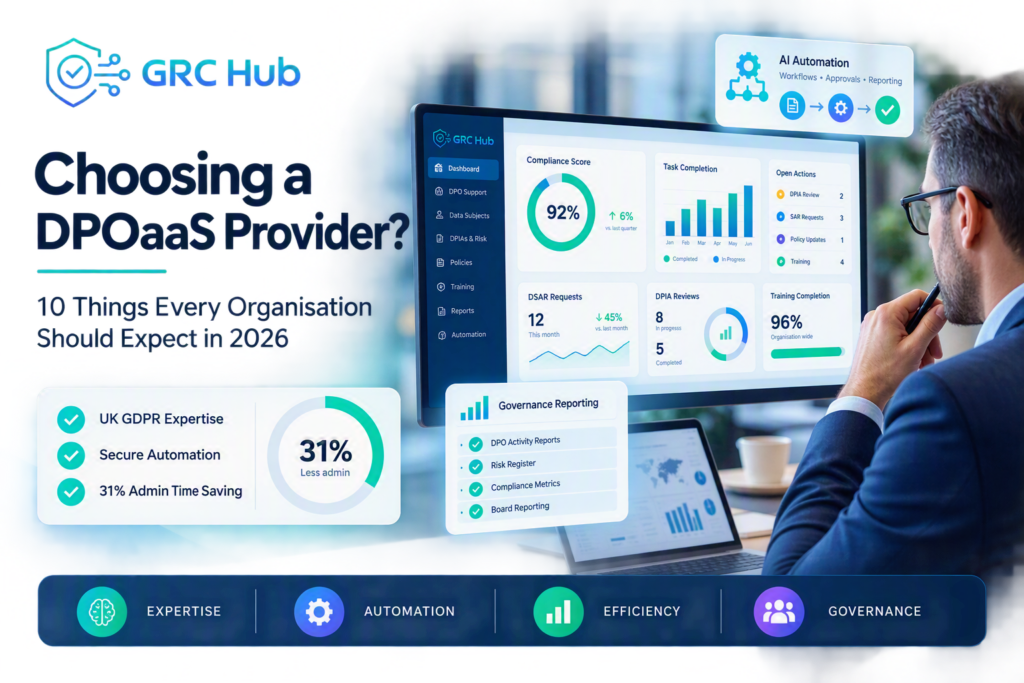
Through our tooling, automation capabilities, standardised methodologies, and operational efficiencies, clients typically experience up to a 31% reduction in administration activities, allowing internal teams to focus on higher-value work while maintaining confidence in their data protection programme.
The right DPOaaS provider should not simply help you remain compliant. They should help your organisation become more efficient, more resilient, and better prepared for the future.
Looking for a More Efficient DPO Service?
GRC Hub combines specialist data protection expertise, governance support, and intelligent automation to help organisations reduce compliance overhead and improve operational efficiency.
About the Author
GRC Hub
GRC Hub provides Data Protection Officer as a Service (DPOaaS), governance support, compliance consultancy, and information governance services to organisations across the UK. Our specialists help clients improve compliance outcomes through expert guidance, proven frameworks, automation, and scalable delivery models.
Contact GRC Hub today to discuss your requirements and arrange an initial consultation. Or view our DPO as a Service Page.

Governance Risk & Compliance Hub LIMITED
© 2026 All rights reserved
- Award Winning consultancy
- Email: hello@grc-hub.co.uk
- Phone: +44 (0) 113 532 7830