Department for Education Cyber Attack: 600,000 Records Exposed and the Lessons for UK Organisations
Introduction
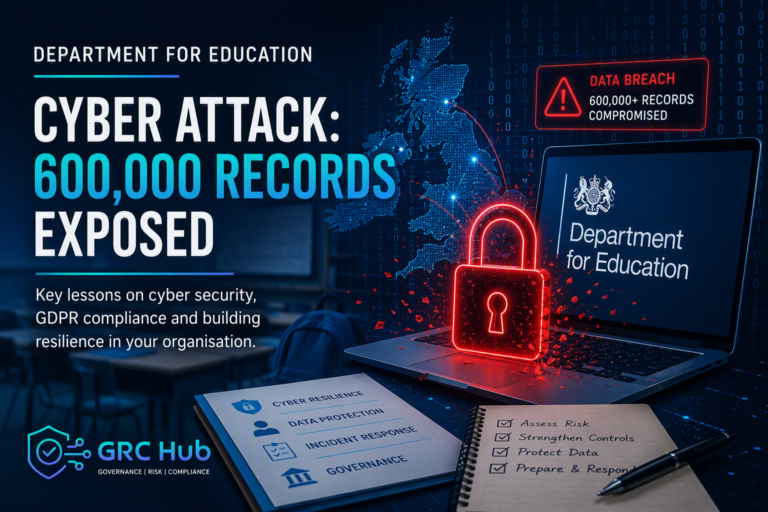
The recent Department for Education cyber attack has once again put cyber security, data protection and organisational resilience firmly in the spotlight. Reports indicate that more than 600,000 records were accessed by attackers, affecting educational and government-related stakeholders across the UK.
While the scale and impact of the incident continue to be assessed, one thing is clear: no organisation is too large, too well-known, or too well-resourced to become a target.
For organisations responsible for personal data, this incident serves as a valuable reminder that cyber security is not simply an IT issue. It is a governance, risk and compliance challenge that requires leadership, visibility and accountability across the entire business.
What Happened?
According to media reports, attackers targeted systems used by the Department for Education to support educational institutions and stakeholders. The compromised information reportedly included contact details associated with school leaders, university staff and government officials.
Although the Department for Education moved quickly to contain the incident and implement response measures, the breach demonstrates how a single attack can have far-reaching consequences for individuals, organisations and public trust.
For businesses, the details of the attack are less important than the lessons it presents.
Every Organisation Is a Target
One of the most dangerous assumptions organisations make is believing they are unlikely to be attacked.
Cyber criminals do not discriminate. Any organisation that processes personal information, stores commercially valuable data or provides critical services represents a potential target.
Whether you’re a school, charity, manufacturer, professional services firm or public sector body, attackers recognise that data has value.
This is particularly true in today’s threat landscape, where stolen information can be used for:
- Phishing attacks
- Identity fraud
- Social engineering
- Business email compromise
- Credential harvesting
- Further cyber attacks
The reality is simple:
If your organisation holds data, it has something worth protecting.
Cyber Security and Data Protection Go Hand-in-Hand
Many organisations continue to treat cyber security and data protection as separate disciplines.
In practice, they are closely connected.
When personal data is compromised, the incident immediately becomes more than a technical issue. Organisations must understand:
- What data was affected
- Which individuals are impacted
- Whether there is a risk to rights and freedoms
- Whether regulatory notification thresholds have been met
- What communications need to be issued
- How accountability will be demonstrated
These considerations sit at the heart of UK GDPR compliance.
Strong security controls help prevent incidents, but effective privacy governance determines how well an organisation manages the consequences when something goes wrong.
Governance Matters More Than Ever
One of the biggest challenges organisations face is visibility.
Many businesses operate dozens of systems, applications, suppliers and cloud platforms that process personal data. Over time, complexity increases and risk follows.
Without effective governance, organisations may struggle to answer fundamental questions:
- Where is personal data stored?
- Who can access it?
- Which third parties process it?
- What security controls protect it?
- How is compliance monitored?
- What happens if a breach occurs?
Good governance creates the visibility needed to answer these questions quickly and confidently.
This is where governance, risk and compliance frameworks become essential. Organisations with mature governance processes are typically better positioned to assess risk, manage incidents and demonstrate compliance when regulators come knocking.
Incident Response Can Make or Break an Organisation
No organisation can guarantee complete protection against cyber threats.
Even businesses with mature security programmes may experience security incidents.
What separates resilient organisations from vulnerable ones is often their ability to detect, contain and respond effectively.
An effective incident response capability should include:
- Clearly documented response procedures
- Defined roles and responsibilities
- Escalation processes
- Regulatory notification procedures
- Legal and communications support
- Business continuity plans
- Regular testing and exercises
Too many organisations focus exclusively on prevention while investing little in response planning.
When an incident occurs, those gaps quickly become exposed.
The Human Factor Remains a Critical Risk
Technology alone cannot solve cyber security challenges.
Many breaches eventually exploit human behaviour, whether through phishing, credential theft or social engineering.
Even when stolen data appears relatively low risk, attackers often leverage that information to launch highly targeted campaigns against employees and stakeholders.
Organisations should ensure employees understand how to identify:
- Suspicious emails
- Unusual login requests
- Unexpected attachments
- Payment fraud attempts
- Requests for sensitive information
Regular awareness training remains one of the most effective and cost-efficient security controls available.
Key Questions Every Organisation Should Be Asking
The Department for Education cyber attack should prompt leaders to evaluate their own risk posture.
Consider the following questions:
Do we have a documented incident response plan?
Have we tested the plan within the last 12 months?
Do we know where all personal data is held?
Are suppliers subject to appropriate security due diligence?
Are access controls reviewed regularly?
Do we have visibility of cyber and privacy risks?
Are staff receiving regular cyber security and data protection training?
Is senior leadership receiving meaningful risk reporting?
Do we have access to DPO or privacy expertise when needed?
If any of these questions are difficult to answer, it may indicate an opportunity to strengthen your governance framework.
Building Resilience for the Future
Cyber incidents are no longer a question of “if” but “when”.
As organisations become increasingly digital and interconnected, the ability to manage cyber risk effectively has become a business requirement rather than simply a technical objective.
The organisations that navigate incidents most successfully are those that invest in:
- Governance
- Risk management
- Data protection
- Security awareness
- Incident response
- Executive oversight
Together, these elements create resilience and provide confidence that risks can be identified, managed and reduced before they become business-critical events.
How GRC Hub Can Help
At GRC Hub, we help organisations build practical, sustainable governance, risk and compliance programmes that strengthen both cyber security and data protection outcomes.
Whether you require:
- Outsourced DPO services
- Privacy management support
- Cyber security governance
- Data protection assessments
- Incident response planning
- Compliance audits
- Risk management frameworks
Our team can help you develop a proportionate approach that aligns compliance requirements with real-world operational needs.
Want to understand how resilient your organisation is to cyber and data protection risks? Get in touch with GRC Hub to discuss a cyber resilience review or data protection assessment.

Governance Risk & Compliance Hub LIMITED
© 2026 All rights reserved
- Award Winning consultancy
- Email: hello@grc-hub.co.uk
- Phone: +44 (0) 113 532 7830